Skip to content

Clean Energy & Mobile Power Division

Electricity Power Harvesters — Cart, Pod & Data-Center BESS.

We engineer three LiFePO4 product lines that buy power when it is cheap and deliver it when it is expensive or unreliable: a rolling Mini-Micro Grid cart for jobsites and backup, a detached residential & commercial power pod, and a container battery plant for data centers and commercial campuses. All charge overnight at ~2.3¢/kWh, run on batteries instead of the grid, and are built and serviced by certified local technicians.

  • LEED Platinum Standards
  • Open-Protocol Energy Architecture
  • Community Trained Technicians
  • Grid Brownout & Outage Protection

Same-day site evaluation

Residential, commercial, warehouse, and data-center sites. We review your interval data, roof or pad conditions, and tariff — then return an engineered savings figure.

Call 404-454-0602

One architecture, four scales

Cart, trailer, home pod, container

The same LiFePO4 bank, inverter stack and system control brain, packaged four ways — from a one-person cart to a container-scale plant.

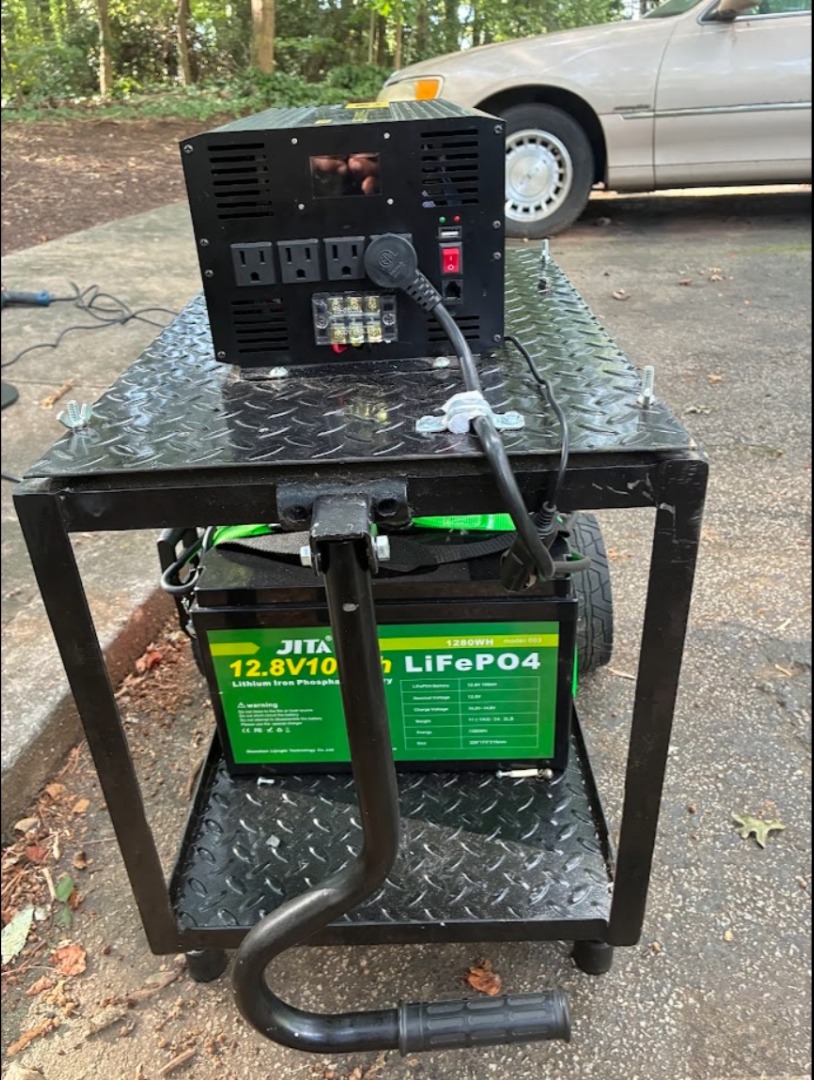
Community-built LiFePO4 generator cart in a steel roll cage with inverter outlet panel
01

Portable · up to four battery modules

Rolling Mini-Micro Grid Cart

The gas-generator form factor crews already trust — tubular roll cage, never-flat wheels, fold-down handle — built as a rolling Mini-Micro Grid. Our demo unit was fabricated by Blackwell Welding Service on Donald Lee Hollowell Parkway in Atlanta and carries up to four battery modules, a pure sine inverter, and direct solar-panel hookups behind a standard outlet panel.

  • 120V/30A outlet panel, pure sine output
  • Holds up to four battery modules in the cart frame
  • Solar panel hookups for silent on-site top-up
  • Charges overnight at ~2.3¢/kWh, from solar, or off an alternator
  • Zero fumes, zero engine noise — safe indoors

For tradespeople, vendors, home backup and mobile worksites
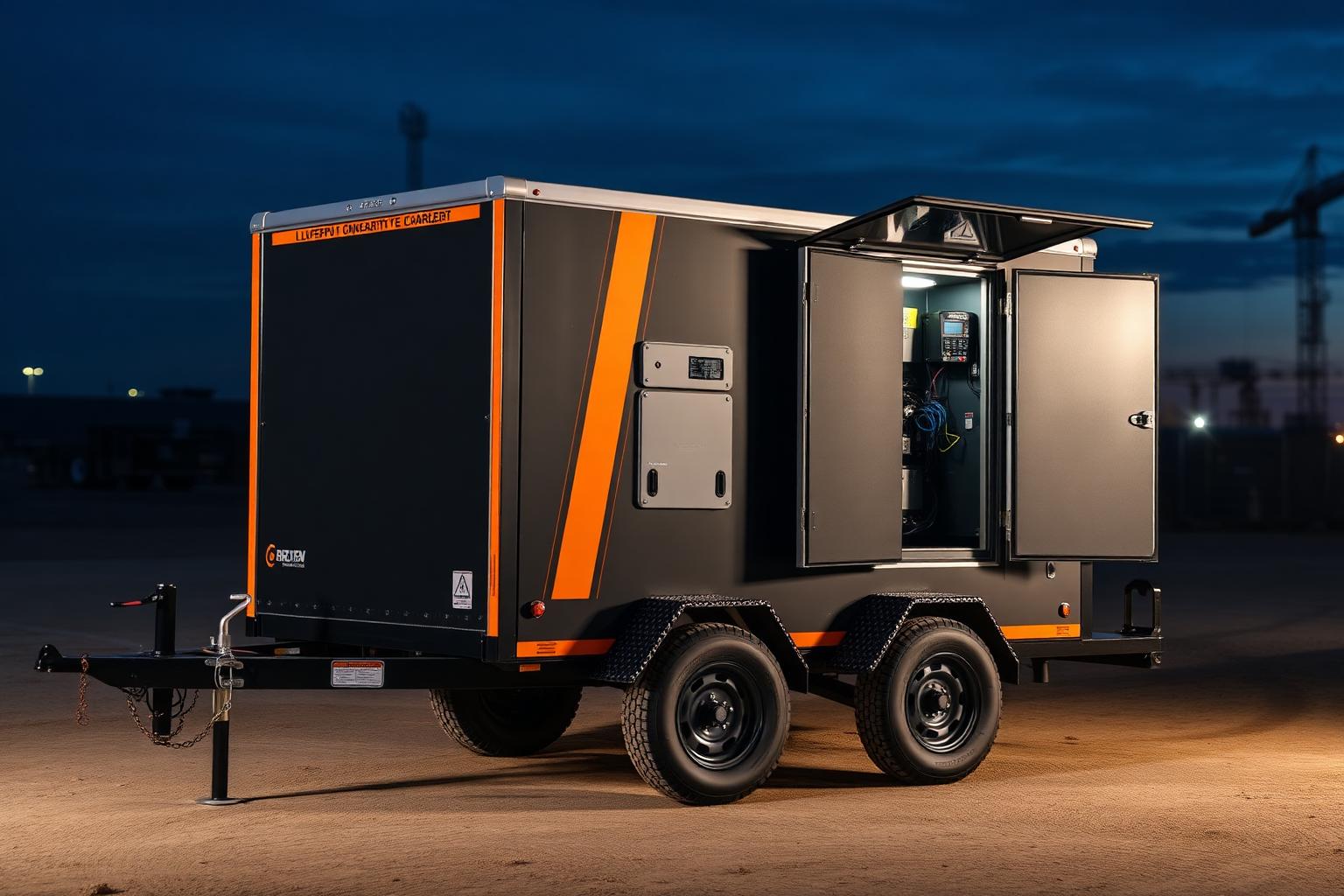
Towable enclosed power trailer with LiFePO4 battery rack, inverter and charger
02

Towable · 20–60 kWh

Towable Power Trailer

The pod architecture on a single-axle chassis: a full LiFePO4 bank, inverter/charger stack and GX controller in a lockable enclosure you hitch up and pull onto any site that needs remote power. Touring crews hitch it behind the bus and stop worrying whether the venue has enough service for the rig — you carry your own power, plug the stage in, and recharge overnight on cheap shore power.

  • 120/240V split-phase output with jobsite distribution panel
  • Shore-power, generator or DC solar recharge inputs
  • EV overnight charging — pull cheap 11 PM–7 AM power through standard J1772 Level 2 stations
  • Silent and fume-free — runs beside the stage, in loading docks and indoors
  • Tour-ready: powers backline, lighting and bus hotel loads where venue service falls short
  • Same controller and monitoring as the fixed vaults

For contractors, touring crews, events and disaster response

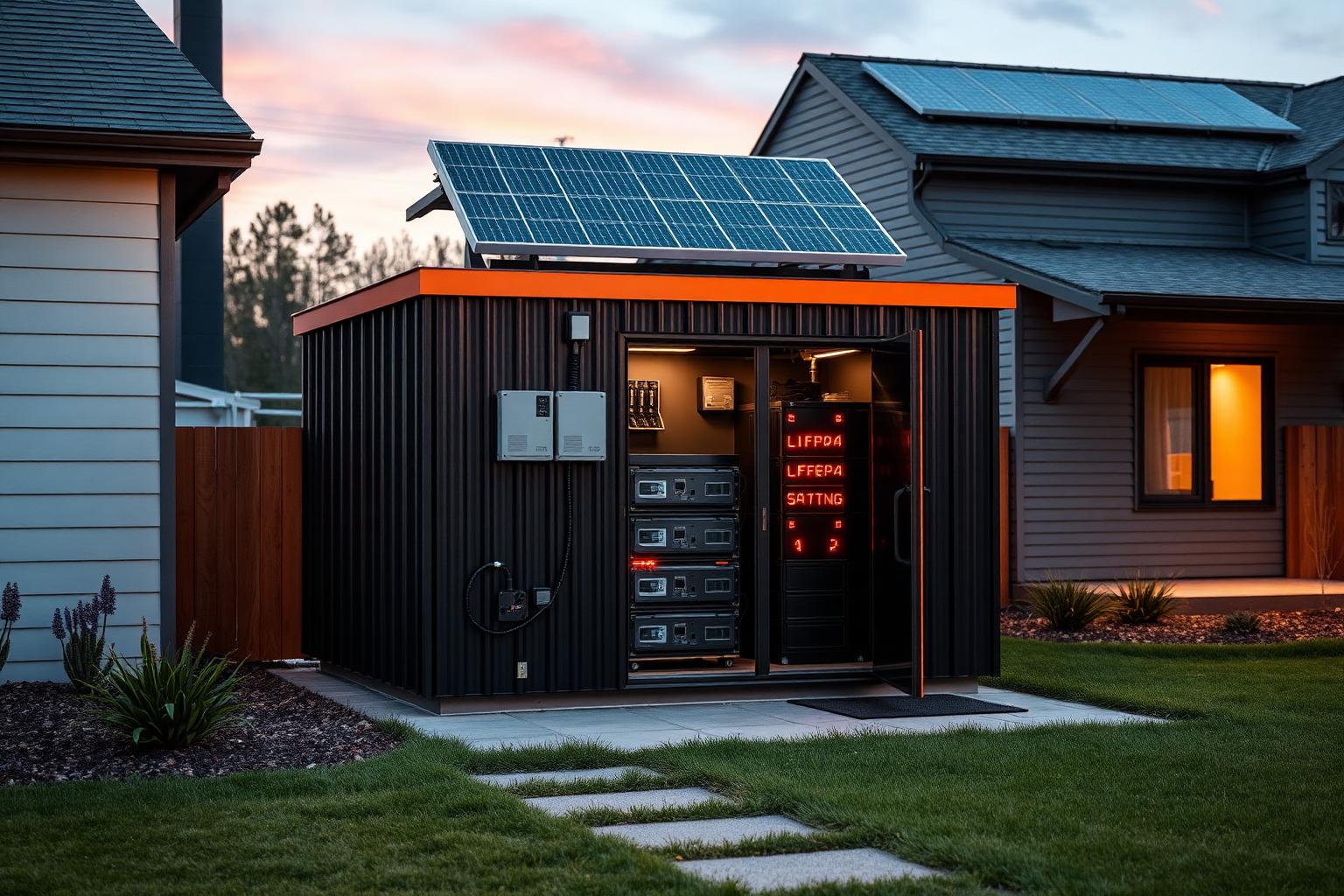
Detached backyard home energy pod with battery vault, inverters and rooftop solar
03

Residential & Commercial · 30–80 kWh

Residential & Commercial Power Pod

A detached outbuilding vault beside the house or business. Storage, inverters and cooling stay outside the living or working space, so permitting moves faster and service never disrupts the household or trading hours.

  • Harvest electricity when it's cheapest
  • Runs on batteries, not the grid — power never flickers or goes out
  • Zero-export DC-coupled rooftop solar capture

For single-family, multi-family and commercial properties

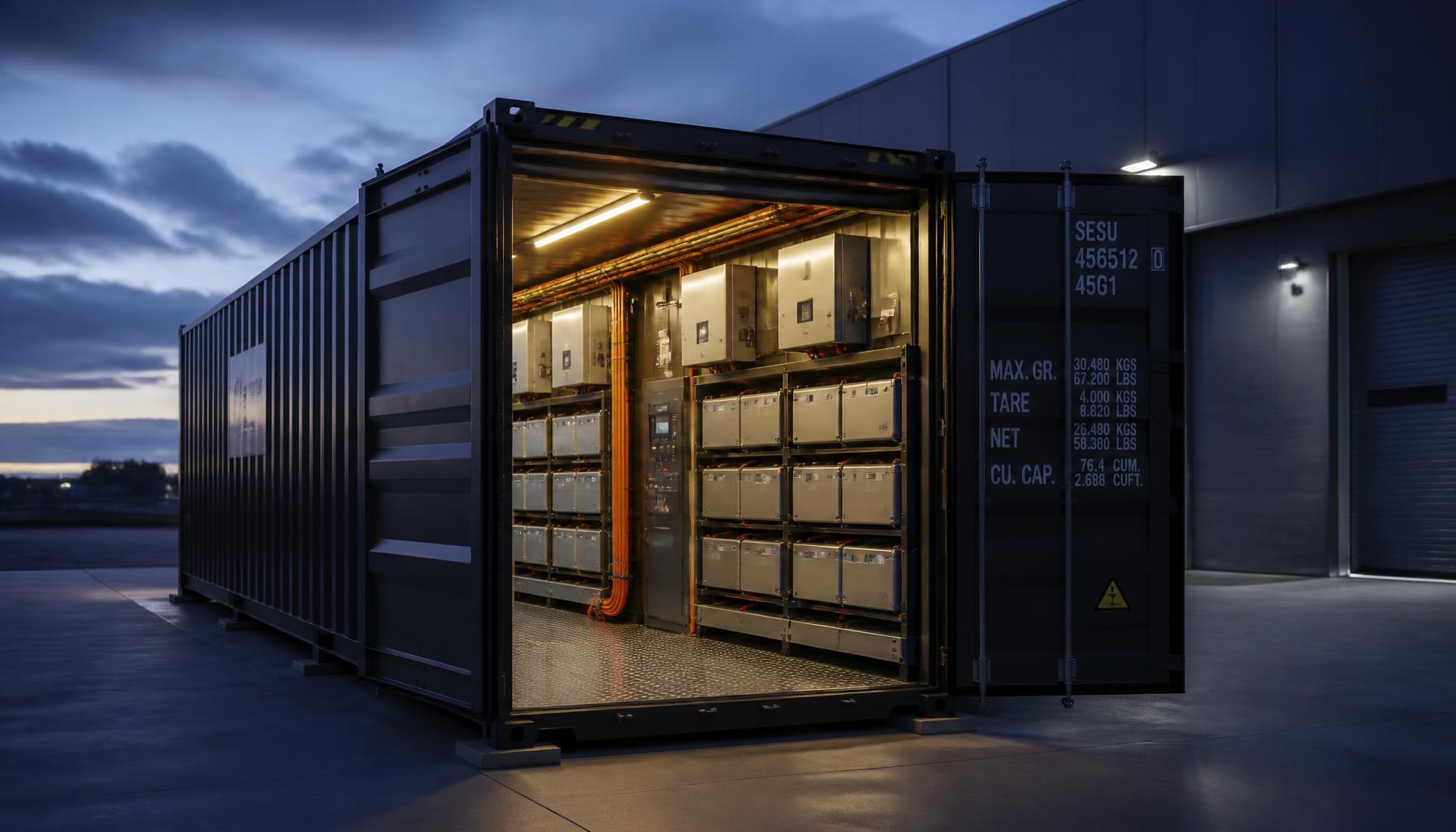
Shipping-container commercial battery energy storage unit beside a warehouse
04

Industrial · 100–500+ kWh

Container Battery Plant

A 20- or 40-foot intermodal container filled with racked LiFePO4 battery modules, industrial inverters, fire separation and active thermal management — delivered and set on a pad. There is no engine, no fuel tank and no exhaust pipe: this is a battery vault, not a generator. It retrofits onto a site you already have, powers your racks off stored electricity you bought at ~2.3¢/kWh, and shaves the peak off the neighborhood transformer at the same time — no diesel, no fumes, no fuel deliveries.

  • Intermodal container packed with LiFePO4 batteries and inverters — no engine, no exhaust, no combustion
  • Retrofit playbook: drops onto existing halls, warehouses, campuses and brownfields — no new substation, no megawatt feeder wait
  • Power racks off off-peak electricity bought at ~2.3¢/kWh instead of peak demand charges
  • Demand-charge shaving and peak-window load defection
  • Instant silent islanding for outage ride-through — no generator, no fuel
  • Grid-stabilizing discharge during transformer overload events
  • Frees compute from the feeder — stand up racks at the load and turn a data center into an edge compute center
  • Locally owned and locally serviced: built, installed and maintained by certified technicians from the block

For data centers, warehouses, fleets and commercial campuses

Residential & Commercial Power Pod

Harvest electricity when it's cheapest.

Your power never flickers or goes out, because your house or business always runs on batteries, not the grid.

See the full platform
Detached home power pod with battery vault, inverters and rooftop solar

Local clock control

Set your own charging hours right on the unit.

No app, no account, no one else touching your schedule. An air-gapped real-time clock lives inside the vault and schedules your charging locally — there is no cloud dependency, no utility access, and nothing a remote party can change, read or switch off. The decision of when you charge stays yours, even when the Wi-Fi goes down.

Container Battery Plant · retrofit & new-build playbook

Batteries inside the container. No exhaust pipe. No engine. No fuel.

A 20- or 40-foot intermodal container packed with racked LiFePO4 battery modules, industrial inverters and active thermal management. Not a generator. Not a diesel backup. A battery vault that drops onto an existing hall, warehouse, campus or brownfield, buys energy when the grid is quiet, discharges through peak windows to dodge demand charges, and rides through outages silently — no diesel, no fumes, no fuel deliveries, no substation queue. Owned and serviced locally, not leased back from a hyperscaler.

Edge compute deployment

Retrofit first. Own it locally. Serve the load where it lives.

The only thing tying compute to a giant centralized facility was the grid — and the megawatt feeder it demanded. Once power lives in a local battery plant, that constraint disappears. You can stand up racks wherever the load actually is — a neighborhood, a campus, a partner's floor, a brownfield site — and serve users from the edge of their own town instead of from a distant regional hub.

  • A repeatable retrofit method

    Same container plant, same commissioning steps, dropped onto buildings that already exist. No new substation, no megawatt feeder, no multi-year interconnection queue.

  • Edge economics

    Off-peak energy bought at ~2.3¢/kWh plus no transmission build-out, no demand charges, no new substation wait.

  • Locally owned, locally serviced

    The plant is owned by the site and maintained by certified technicians from the block — compute capacity that keeps its money in the neighborhood.

  • Sovereign isolation

    Each edge site carries its own clean silent ride-through. One outage at the core no longer takes down the network.

The ownership model

The client funds the build. The block owns what gets built.

A vault on your site is not something you rent or lease back. Your money pays for the plant once — the batteries, the inverters, the land it sits on — and what is built stays owned by the neighbourhood that built it.

01 · Paid for once

Customer-funded capacity

The build is paid for upfront by the site it serves. In return the site holds its own power and compute capacity — an asset it owns, not a service contract.

02 · Kept close

Owned by the block

Land and equipment sit in a community-held entity. The people where it is installed own the plant and its earnings, and no outside interest holds a stake.

03 · Maintained locally

Serviced by local technicians

Certified technicians from the block build, commission and service every plant. The jobs and the money stay in the neighbourhood.

Global sourcing, local build

A worldwide parts map protects the neighborhood.

We source the best cells, inverters and switchgear from wherever they are made best — and we build, own and service every plant right here on the block.

A global mindset is not about shipping jobs overseas. It is about resilience: even American suppliers face strikes, bankruptcies, fires and tariff shocks. By qualifying multiple cell and inverter sources across continents, we make sure one supplier's shutdown never shuts down a community's power plant. The jobs stay local. The ownership stays local. The parts map stays diversified.

  • No single point of failure

    Cells, inverters and switchgear sourced from qualified vendors in multiple regions.

  • Local assembly & service

    Vaults, pods and containers are welded, wired and commissioned by certified block technicians.

  • Supplier shocks never strand projects

    If one region or factory goes offline, alternate parts keep builds on schedule.

  • Community keeps the equity

    Global sourcing lowers capex; local build and ownership keep the value in the neighborhood.

Grid resilience

Stop brownouts, flickers & outages at the source

Data centers and AI compute are pulling record power through aging neighborhood transformers. Our distributed LiFePO4 vaults absorb that peak demand locally — so the lights stay on and the voltage stays steady.

Neighborhood peak shaving

Container and pod-scale banks discharge during evening and summer peaks, trimming the top off transformer and feeder load before utilities fire up dirty peaker plants.

Flicker & sag correction

Sub-second inverter response irons out voltage sags from compressor starts, EV charging clusters and data-center ramp events — no more dimming lights or tripped equipment.

Seamless outage ride-through

When the grid goes down, the vault instantly islands critical loads. No fumes, no fuel deliveries, no generator maintenance — just clean silent power until utility service returns.

Community-owned resilience

Every vault is built, commissioned and serviced by certified local technicians. Resilience becomes a neighborhood asset and a local paycheck, not a remote utility program.

Standard installation model

Detached outbuilding power vaults

High-voltage storage, inverters and cooling live in a dedicated exterior pod — faster permitting, zero living-space intrusion, and service without disturbing occupants.

Standard installation model

The Detached Power Vault

Every EPS stationary system ships as a dedicated exterior pod — a shed, utility enclosure or separate storage structure sited beside the building it serves. Batteries, inverters, cooling and the system controller all live there.

Footprint
6' × 8' pod typical
Capacity
15 – 120 kWh LiFePO4
Thermal
Isolated, actively vented
Water
Magnetic scale conditioning

Frictionless Permitting & Fast Inspection

A detached pod sidesteps the complex indoor residential living-space electrical restrictions that stall interior installs. Inspectors sign off faster because the energy storage never enters a habitable room.

Zero Living Space Intrusion

High-voltage battery storage, inverters and active cooling stay completely outside the main home or commercial building — no closet sacrificed, no fan noise, no thermal load added indoors.

Rapid Serviceability

Technicians service, upgrade or hot-swap battery modules inside an isolated exterior vault without entering the building or disrupting occupants, tenants or trading hours.

LEED & Safety Optimized

Thermal isolation, dedicated fire separation, and non-chemical magnetic scale water conditioning are integrated into the pod footprint from the first drawing.

Gas generator replacement

Mobile silent LiFePO4 generators

Community-built heavy-duty power stations for jobsites, emergency backup, food trucks and events — charged three ways, with no fumes and no noise.

Rolling Mini-Micro Grid — demo unit

A gas-generator footprint with battery, inverter and solar hooks behind the panel

Our demo cart was fabricated by Blackwell Welding Service at 2994 Donald Lee Hollowell Pkwy in Atlanta. It holds up to four battery modules, a pure sine inverter, and direct solar-panel hookups in the exact chassis crews already trust — tubular roll cage, never-flat wheels, fold-down tow handle, and a standard 120V/30A outlet panel. It drops into the same jobsite workflow with none of the fumes, fuel cans, or pull-cord starts.

Built By The Block

Blackwell Welding Service built this frame in Atlanta

The roll cage on our demo unit was designed and welded by Blackwell Welding Service on Donald Lee Hollowell Parkway — a local Atlanta fabricator that knows the gas-generator chassis crews already trust. Tubular frame, never-flat wheels, fold-down tow handle, standard outlet panel. Same workflow you run today, so your crew doesn't relearn anything. The craft is local; the reliability is engineering.

Finished one-of-a-kind

A neighborhood painter makes yours the only one

No two units leave with the same finish. A local painter hand-finishes each cart, so a shop owner gets a workhorse that disappears into the job and a collector gets a bespoke object — signed, numbered, and unlike anything else on the block.

For everyone watching the price at the pump and the meter.

Gas prices climb, electricity rates climb, and every combustion generator burns fumes you have to stand downwind of. One community-built cart answers all three at once: charge overnight at ~2.3¢/kWh, carry power where the extension cord won't reach, and run it with zero fumes and zero engine noise — indoors, at the jobsite, or on the showroom floor.

Welded local · Painted unique
01

Home / Business Super Off-Peak

Plug into any standard 120V or 240V outlet overnight and fill the pack on ~2.3¢/kWh super off-peak power. A full charge costs less than a coffee.

02

In-Transit DC-to-DC Alternator Charging

A heavy-duty isolated DC-DC charger taps your van, truck or fleet vehicle's alternator so the unit refills while you drive between jobs — no idling, no downtime.

03

Rapid Solar DC Coupling

Direct MC4 inputs accept folding briefcase arrays or roof-mounted panels for silent top-ups on site, on the trail, or during multi-day outages.

Zero deadly fumes. Pure silence.

No combustion means no carbon monoxide, so the unit runs safely indoors, inside enclosed trailers, and in basements. Zero exhaust, zero engine noise — legal to run through night-time noise curfews and quiet-hours ordinances.

0 dB engine · 0 ppm CO
  • Jobsite tool & compressor power
  • Emergency home backup
  • Food trucks & vendor carts
  • Outdoor events and night shoots
  • Fleet & service van workstations
  • Disaster response staging
  • Touring bus & stage rigs at underpowered venues

On-demand hydrogen

Cheap HHO & H2, made on the block from off-peak power

Water and 2.3¢/kWh overnight electricity go in; hydrogen comes out at the moment of use. No tank farm, no tanker deliveries, no stored inventory — point-of-use generation powered by the same harvester architecture.

Electricity cost per kg H2

~$1.30–1.40

50–55 kWh/kg at super off-peak rates

Delivered merchant hydrogen

$12–36/kg

Tanker-trucked, plus delivery windows

Water consumed

~9 L/kg

Deionized or distilled feedstock

01

E-Generator Cart supplies the power

The community-built LiFePO4 cart charges overnight on super off-peak power and delivers clean 120/240V pure sine output — enough to run an electrolysis unit anywhere, with no grid tie, no fuel can and no exhaust.

02

Standard PEM electrolyzer makes the gas

A standard single- or split-phase electrolyzer splits deionized water into hydrogen and oxygen on site. Roll it out, fill the reservoir, and start producing — the fuel is manufactured where it is burned.

03

Tankless by design

We never store hydrogen. Gas is generated at the rate of consumption and consumed immediately, which keeps the deployment out of tank-farm fire code territory and off the delivery schedule entirely.

Where it fits today

  • HHO torch and brazing work in local metal shops
  • Fuel-cell forklift fleets in 24/7 distribution centers
  • Mobile fuel-cell carts and field power
  • Industrial process heat and burner feedstock
  • Remote and off-grid sites where delivery cost dominates
  • Shop demonstrations and technician training on the block

Rate arbitrage model

Interactive savings calculator

Move the sliders to see your tiered utility bill against a super-off-peak battery arbitrage plus zero-export solar pairing.

$320
$100$1,000+
2,400 ft²
800 ft²12,000 ft²

Roof area drives the zero-export array we can pair with the vault — currently modelling 10% solar self-supply.

Monthly cost comparison

Standard tiered utility bill$320
Off-peak arbitrage + zero-export solar$209

Peak-window energy cost cut by 89% by charging 11 PM – 7 AM at ~2.3¢/kWh and defecting through the 2–7 PM window.

Est. monthly savings

$111

Peak demand reduction

7.1 kW

10-year retained equity

$8,250

Estimates model utility-style time-of-use tariffs with a 92% round-trip LiFePO4 efficiency. Your site assessment produces a binding engineered figure.

The closed-loop system

Why off-peak wins, in three moves

01

11 PM – 7 AM

Super Off-Peak Overnight Charging

The system pulls power automatically between 11 PM and 7 AM at rock-bottom super off-peak utility rates — roughly 2.3¢/kWh on your local utility's time-of-use tariffs — and fills the LiFePO4 vault while the grid is quiet.

02

2 PM – 7 PM

Peak-Hour Load Defection

During the utility's peak pricing window the house automatically disconnects from expensive grid energy and runs 100% on stored LiFePO4 power plus live rooftop solar. No behaviour change, no load shedding, no dimming the lights.

03

Daylight

Zero-Export Solar Capture

Every watt your roof makes goes straight into the batteries as DC instead of being exported back to the utility for a fraction of its retail value. Self-consumption beats buyback credits on every Southeast tariff we have modelled.

Modular hardware

Pick the control surface your building deserves

Headless local control core

Tier 1 — Stealth Industrial Node

The full system controller with no display, hidden inside a server rack or utility closet. Monitoring lives entirely in the mobile app and browser dashboard.

  • Interface: Headless — mobile app & browser
  • Placement: Server rack / utility closet
  • Processing: Local controller, 1 GB RAM
  • Local clock control: Air-gapped RTC scheduling, no cloud dependency
  • Offline reliability: Full autonomous operation without internet

Controller + local touch display

Tier 2 — Modular Living-Space Console

The same controller brain paired with a flush wall-mounted 5" or 7" local touch display in the living space, so the household can read state of charge at a glance.

  • Interface: Flush 5" or 7" local touch panel
  • Placement: Wall-mounted, living space
  • Processing: Local controller + dedicated display bus
  • Local clock control: Air-gapped RTC scheduling, editable on-panel
  • Offline reliability: Panel keeps full read/write control offline

All-in-one touch command hub

Tier 3 — Executive Touch Command Hub

An integrated 7" high-performance colour touchscreen and controller in one unit, mounted directly into your wall or console.

  • Interface: Integrated 7" high-performance colour touchscreen
  • Placement: In-wall or console flush mount
  • Processing: Quad-core controller, 2 GB RAM, faster refresh
  • Local clock control: Air-gapped RTC with multi-schedule profiles
  • Offline reliability: Full local UI and control with zero connectivity

Turnkey services

Engineered, installed and maintained by the block

Custom Engineering & Permitting

Full system sizing against twelve months of your interval data, sub-panel and critical-load configuration, stamped drawings, and utility interconnection filed on your behalf.

  • Load study & vault sizing
  • Sub-panel design
  • Utility interconnection filing

Certified Rooftop Solar Integration

We partner with certified local solar installers for complete roof-to-vault DC coupling, so the array and the battery are engineered as one system instead of two bolted together.

  • DC-coupled array design
  • Certified installer partners
  • Roof-to-vault commissioning

Lifetime Monitoring & Community Maintenance

Tiered ongoing maintenance contracts staffed by local certified technicians: firmware audits, cell-level battery health checks, and rapid on-site component replacement.

  • Essential — annual firmware & health audit
  • Standard — quarterly audits, 48h on-site response
  • Sovereign — monthly telemetry review, 12h response, loaner hardware

Can't call right now?

Send your details and we will call you back

Four short steps. A local certified technician pulls twelve months of your interval data, models your tariff, and returns an engineered savings figure — no obligation, no sales theatre. Prefer speed? Call 404-454-0602.

  1. 01 Solution
  2. 02 Property / vehicle
  3. 03 Location & spend
  4. 04 Schedule

What are you interested in?

Step 1 of 4
404-454-0602